
Thread Lift vs. Surgical Facelift: A Cosmetic Surgeon’s Honest Comparison
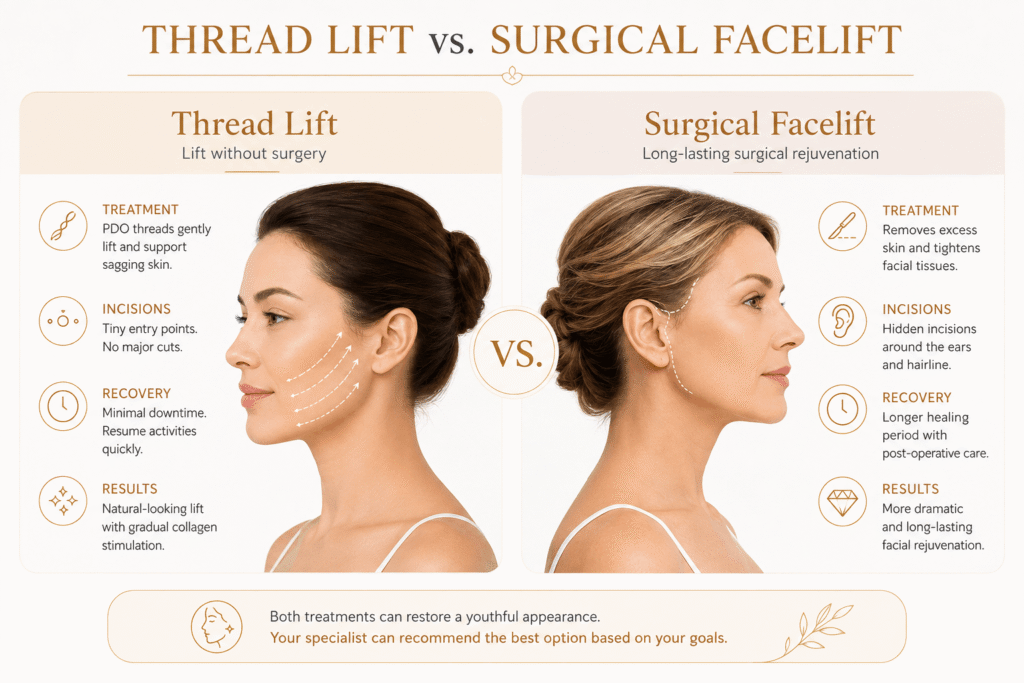
If you have noticed the skin along your jawline beginning to soften, your midface losing its youthful fullness, or fine lines deepening at the corners of your mouth, you are likely already researching what comes next. Two options dominate this conversation: the thread lift, a minimally invasive skin tightening treatment that has gained enormous traction in recent years, and the surgical facelift, the long-established gold standard for facial rejuvenation.
Both work. Both lift. But the scale of each, the degree of correction, the recovery required, the longevity you can realistically expect, and the type of aging each is suited to address differ significantly. This comparison is written from a clinical standpoint, without the marketing gloss that too often clouds patient decision-making.
What Is a Thread Lift? The Non-Surgical Facelift Explained
A thread lift is a minimally invasive cosmetic procedure in which dissolvable sutures and medical-grade threads are inserted beneath the skin using fine needles or cannulas. Once in place, these threads do two things: they create an immediate mechanical lift by repositioning sagging tissue, and they stimulate the body’s collagen production in the surrounding area as they dissolve, providing longer-lasting skin quality improvements beyond the initial lift.
Thread lifts are performed under local anaesthesia and typically completed in 45 to 90 minutes. Patients can usually return to their regular social activities within a week, making it a popular choice for those who cannot accommodate the recovery window of surgical intervention.
The Three Thread Types — PDO, PLLA, and PCL
Not all threads are created equal. The material used directly affects absorption rate, collagen stimulation intensity, longevity of results, and clinical suitability. Understanding these distinctions is essential before a thread lift consultation.
PDO (Polydioxanone) Threads
PDO is the most widely used thread material in aesthetic medicine, largely because of its long-standing safety record. Polydioxanone has been used in cardiac and orthopaedic surgery for decades. PDO threads dissolve within 4 to 6 months in tissue but trigger a meaningful collagen response that sustains the result beyond the thread’s physical presence. They are particularly effective for targeted lifting in specific areas and are generally the most cost-effective option. For patients wanting immediate mechanical lift, PDO cog threads (barbed sutures) remain the preferred choice among many surgeons.
PLLA (Poly-L-Lactic Acid) Threads
PLLA threads are the same material used in Sculptra, a biostimulatory filler well established for collagen induction. PLLA threads dissolve over 12 to 18 months and provide a stronger and more sustained collagen stimulation than PDO. The tradeoff is that results build gradually rather than appearing immediately, and the upfront cost is higher. PLLA is better suited to patients looking for progressive, natural-looking improvement with longer results.
PCL (Polycaprolactone) Threads
PCL threads are the most slowly absorbed of the three, dissolving over 18 to 24 months while providing ongoing structural support and biostimulation throughout their presence. PCL is suited to patients seeking the longest possible thread-based maintenance cycle and the strongest cumulative collagen response. They are not yet as widely available as PDO or PLLA.
A 2025 systematic review in Aesthetic Plastic Surgery, analysing 192 publications, found that absorbable thread lifts provide meaningful initial improvement that declines as sutures dissolve, with the lifting effect generally diminishing substantially within 12–18 months. The takeaway: threads work temporarily. A patient who understands and accepts this maintenance reality is a good candidate.
What Is a Surgical Facelift? The Gold Standard Defined
A facelift (rhytidectomy) is a surgical procedure that repositions and tightens the deeper structural layers of the face, specifically the SMAS (Superficial Musculo-Aponeurotic System), the layer of muscle and connective tissue that gives the face its structural shape. By lifting and securing these deeper tissues rather than simply pulling the skin, modern facelift techniques deliver natural-looking results that can last significantly longer than any non-surgical intervention.
There are several surgical approaches, each suited to different degrees of aging and patient anatomy:
- Traditional SMAS facelift: Addresses lower face and neck with results lasting 7–10 years
- Deep plane facelift: Elevates deeper tissue layers for more comprehensive rejuvenation; results lasting 10–15 years
- Mini facelift: Shorter incisions, less recovery; suited to earlier-stage correction; typically lasts 5–7 years
The national average surgeon’s fee for a traditional facelift reached USD 11,395 in 2024, according to the American Society of Plastic Surgeons. When anaesthesia, facility fees, and post-operative care are included, total costs in the United States range from USD 15,000 to USD 20,000. In India, surgical facelift costs at qualified cosmetic surgery centres typically range from ₹2,50,000 to ₹6,00,000+, depending on the technique and the surgeon’s expertise.
Thread Lift vs. Facelift: The Direct Comparison
| Thread Lift | Surgical Facelift | |
| Procedure Type | Minimally invasive; no incisions | Surgical; requires incisions and anaesthesia |
| Anaesthesia | Local anaesthesia + topical numbing | General or deep sedation anaesthesia |
| Downtime | 2–5 days; back to social activities in ~1 week | 2–4 weeks; return to full activity in 4–6 weeks |
| Ideal Candidate | Mild to moderate skin laxity; ages 35–55 | Moderate to severe skin laxity; ages 45–70+ |
| Lifting Effect | Subtle to moderate; best for early-stage sagging | Dramatic and comprehensive; repositions deep tissue |
| Duration of Results | 12–18 months (lifting); collagen benefits persist longer | 7–10 years (SMAS); 10–15 years (deep plane) |
| Thread Types | PDO, PLLA, PCL — each with different longevity | Not applicable |
| Risk Profile | Low; temporary bruising, swelling; rare migration | Higher; includes scarring, nerve injury, haematoma |
| Cost (approx.) | USD 1,500–4,500 / ₹40,000–1,20,000 | USD 8,000–17,500+ / ₹2,50,000–6,00,000+ |
| Reversibility | Threads dissolve naturally; not surgically reversible | Permanent structural changes |
| Addresses Skin Texture | Partially (collagen stimulation) | No — requires adjunct treatments |
| Best For | Prevention; refreshing early aging; pre-surgery delay | Significant correction; long-term transformation |
Thread Lift Before and After: Setting Realistic Expectations
One of the most common sources of patient dissatisfaction with thread lifts is the gap between expectation and outcome, and this gap is almost always created by marketing imagery rather than clinical reality.
Thread lift before and after photographs can look impressive, particularly immediately post-procedure when swelling and tissue displacement contribute to a temporarily enhanced result. Here is what clinical evidence actually supports:
- A thread lift creates a subtle to moderate improvement in skin position, not a dramatic structural transformation
- The most visible improvement is typically seen in the 2–4 weeks following treatment as swelling resolves and collagen stimulation begins
- Results are most satisfying in patients with mild to moderate laxity, early-stage jowling, slight midface descent, or softening of the jawline definition
- Patients with significant skin excess, deep jowling, or neck laxity will generally be underserved by threads and are better surgical candidates
The best thread lift outcomes are also the most conservative ones, with practitioners who insert an appropriate number of threads for the anatomy and tissue quality, rather than overpromising with excessive thread counts.
Who Is a Good Candidate for Each?
You are a good Thread Lift candidate if:
- You are in your late 30s to mid-50s with mild to moderate skin laxity
- You want meaningful improvement without surgery and its associated downtime and risk
- You understand and accept that the procedure is a temporary treatment requiring periodic maintenance
- You have realistic expectations of improvement, not transformation
- You are using a thread lift to delay rather than permanently avoid surgery
Surgery is the better path if
- You have significant skin excess, deep jowling, or advanced neck laxity that threads cannot adequately address
- You want long-lasting results and are prepared for the recovery period
- You have already undergone multiple thread lift cycles with diminishing returns
- Your anatomy requires repositioning of deeper structural tissue, not just surface lifting
- You are in good general health and are a suitable candidate for anaesthesia
An important clinical note: thread lifts and facelift surgery are not interchangeable. They exist on a continuum of aging intervention: threads for early-stage treatment, surgery for meaningful correction. A good cosmetic surgeon will tell you honestly which stage you are at.
Thread Lift Cost in India: What to Expect?
Thread lift treatment cost in India varies considerably depending on the thread material used, the number of threads required, the practitioner’s qualifications, and the clinic’s standards of care. At qualified cosmetic surgery practices, approximate ranges are:
- PDO thread lift: ₹40,000 to ₹80,000 per session
- PLLA thread lift: ₹60,000 to ₹1,20,000 per session
- Full-face thread protocol (combination): ₹80,000 to ₹1,50,000+
As with all cosmetic procedures, cost should be considered alongside the practitioner’s qualifications, the product source and certification, and the clinical safety environment not as the primary decision criterion.
When Surgery Is the Honest Answer
There is a pattern that experienced cosmetic surgeons recognise: patients who have undergone several thread lift cycles, each delivering less lift than the last, who would have been better served by a surgical option years earlier. This is not a failure of the thread lift as a procedure; it is a failure of candidacy assessment.
If a thorough consultation reveals that your degree of skin laxity, tissue quality, or anatomical structure places you outside the realistic remit of thread lift results, surgery is not a step up from non-surgical it is simply the appropriate tool for the clinical problem you have. At Celeb U, our approach is to be direct about this distinction. We are a surgical practice with full non-surgical capabilities, which means we are not incentivised to push threads when surgery is genuinely the better clinical answer, or to recommend surgery when a well-selected thread protocol will deliver a satisfying result.
Book a thread lift or facelift consultation at Celeb U and receive an honest, anatomy-based assessment, not a procedure recommendation driven by availability. Our senior cosmetic surgeons will map the right intervention to where you actually are, not where you wish you were.