
If you’ve been told you need dental implants but don’t have enough jawbone to support them, you’ve probably come across the basal vs traditional debate. It’s worth understanding the real difference – not just the marketing version – because the two techniques work on completely different principles and suit very different patients.
Conventional implants – what most people picture when they hear the word implant – rely on the alveolar bone, the softer spongy bone that sits just below the gum. Basal implants go deeper, anchoring into the harder cortical bone beneath. That single difference drives everything else: the surgical approach, the healing timeline, and who actually benefits from each. If you’re looking at treatment in Bengaluru, don’t let the “teeth in one day” headline make the decision for you. Speed is not a clinical plan. Before anything else – before you agree to a procedure, before you discuss price – you need a proper examination, a CBCT scan, and an honest look at your bone anatomy and bite forces.
What is the difference between basal and traditional dental implants?
The real difference comes down to one question: where does the implant get its grip?
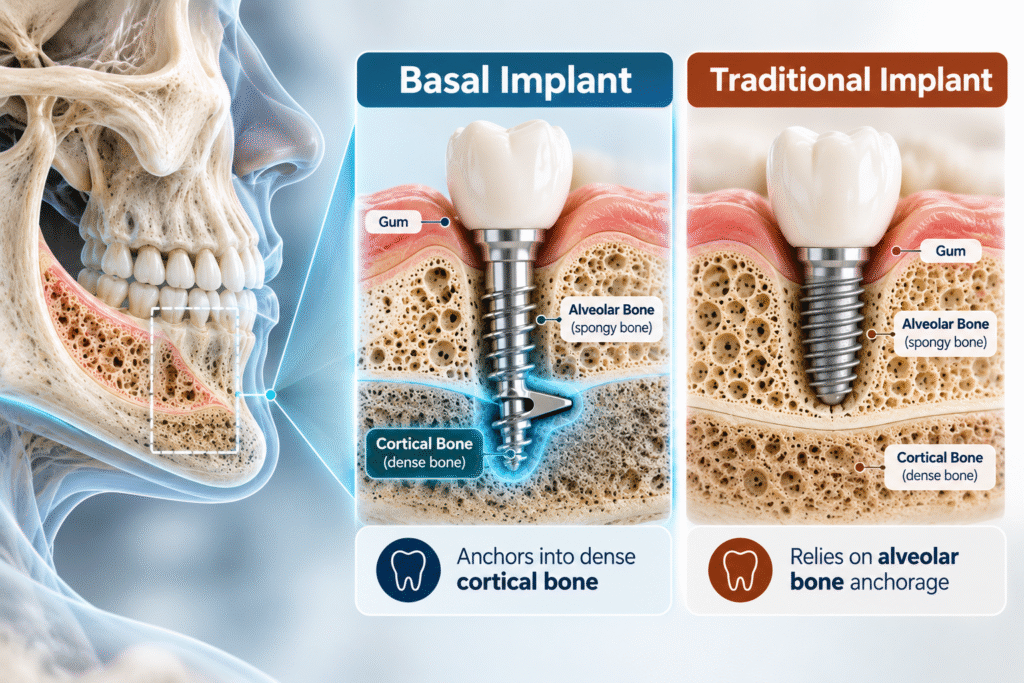
With conventional implants, the fixture goes into the alveolar bone and you wait. Osseointegration – the process of bone growing into and around the implant surface – takes time. Depending on the case, that healing window runs from a few weeks to several months before a permanent crown or bridge goes on.
Basal implants skip that waiting game by anchoring into the cortical bone – denser, harder, and much less prone to resorption. Because the mechanical grip is immediate, the protocol is built around loading the implant right away rather than leaving it undisturbed to heal.
For patients who’ve worn dentures for years, or who lost teeth a long time ago, this matters enormously. The alveolar bone shrinks when it’s not stimulated by tooth roots. By the time someone reaches a clinic after a decade with dentures, there may be very little alveolar bone left to work with.
In simple terms:
| # | Factor | Basal Implants | Traditional Implants |
| 1 | Primary anchorage | Dense cortical/basal bone | Usually alveolar jawbone |
| 2 | Bone-loss cases | Can be considered in selected severe bone-loss cases | May require bone augmentation |
| 3 | Loading | Immediate in appropriately selected cases | Frequently delayed |
| 4 | Treatment timeline | Potentially days rather than months | Often several months |
| 5 | Bone grafting | May be avoidable in suitable cases | May be recommended when bone volume is inadequate |
| 6 | Case selection | Technique-specific and highly operator-dependent | Broadly established treatment option |
| 7 | Best suited to | Patients requiring rapid rehabilitation or with challenging bone conditions | Patients with adequate bone and conventional implant indications |
Basal implants: Understanding the cortical bone advantage
The cortical bone argument is the one you’ll hear most often from clinicians who favour basal protocols. And it’s grounded in something real.
The jaw isn’t one uniform block of bone. The outer cortical shell is dense and compact. Beneath it is the cancellous or spongy bone, which is lighter and more porous – and also more vulnerable to resorption. Conventional implants planted into an area with depleted cancellous bone can struggle for stability, and that’s often where a surgeon brings up grafting or sinus lifts.
Corticobasal implantology sidesteps that problem. The implant reaches past the depleted zone into the dense cortical structures that remain intact almost regardless of how much surface bone has been lost. Published literature defines these as implants that achieve fixation specifically in cortical bone and are intended for immediate functional loading.
That’s why patients who’ve been turned away from conventional implants due to severe bone loss often end up looking at basal options.
But – and this is worth saying clearly – “no graft needed” is not the same as “no assessment needed.” A CBCT scan is still non-negotiable. The scan maps the cortical structures available, identifies nerves and sinuses, and gives the surgeon a three-dimensional picture of where the implant can safely go. Skipping that step because the procedure sounds simpler is not a shortcut. It’s a risk.
Traditional implants: Why they remain the standard choice for many patients
Conventional implants have a decades-long track record. A titanium fixture goes into the jaw, the bone grows around it over the following weeks or months, and then the final crown, bridge, or prosthesis is fitted on top. It’s a slower process – but for patients with good bone, it’s one of the most predictable procedures in modern dentistry.
When the anatomy is favourable, a conventional implant is hard to beat. Good bone, healthy gums, a straightforward missing-tooth case – in that scenario, the standard approach delivers reliable, well-documented outcomes.
And the versatility is real. Conventional implants work across a wide range of situations:
– Single missing teeth
– Multiple missing teeth
– Implant-supported bridges
– Denture stabilisation
– Full-arch rehabilitation
Speed is not the goal. A result that lasts is. If a conventional implant can deliver that – with a predictable timeline and well-understood risk profile – choosing a more specialized technique for the sake of saving a few months doesn’t make clinical sense.
Any recommendation worth trusting starts with the patient’s anatomy and long-term needs – not with which technique a clinic happens to specialize in.
Cortical implants vs conventional implants: What actually changes?
Strip away the terminology and what you’re comparing is two different strategies for making an implant stay put.
Conventional treatment leans on biology. The implant sits in the alveolar bone, and over weeks, bone cells grow into its surface. That biological bond becomes the long-term anchor.
Basal approaches lean on mechanics. The implant grips the cortical bone structurally – like a screw in a dense substrate – and the teeth go on quickly, before that biological integration is complete.
For someone with a heavily resorbed ridge, that mechanical approach opens up options that biology alone can’t.
A 2026 meta-analysis of randomized controlled trial data found no statistically significant difference in implant survival between immediate and conventional loading protocols for single implants across multiple follow-up intervals – though the researchers noted that certainty of evidence varied between outcomes.
Earlier systematic reviews back that up in well-selected cases, but also flag that certain situations – particularly where primary stability is borderline – show a higher failure rate with immediate loading than with the staged approach.
So the honest message isn’t “immediate loading is better.” It’s that immediate loading works well in the right case. Getting to that conclusion requires actual clinical assessment, not a blanket protocol.
Same-day dental implants in India: Is it really possible?
Yes, it is possible.
However, “same-day teeth” means different things to different clinics. Patients need to ask exactly what they’re being promised.
In some protocols, the implant goes in on the same day a tooth is removed. In others, you get a temporary fixed prosthesis attached within hours or a day or two. Neither of those is the same as walking out with your permanent teeth done.
If you’re considering same-day dental implants, make sure you know what “same-day” actually means in your treatment plan. Ask your dentist whether the implant will be placed on the day of treatment, whether you’ll receive temporary teeth immediately, and when your permanent teeth will be ready.
This matters because getting teeth on the same day does not always mean getting your final set of teeth. In many cases, the first teeth are temporary and are designed to help you eat, speak and smile while your mouth heals. The permanent prosthesis is fitted later, once the dentist is satisfied that the implants and surrounding tissues are ready.
Understanding these stages beforehand can help you avoid confusion and set realistic expectations about your treatment.
Who may be a candidate for basal implants?
Basal implants are worth discussing if you fit one or more of these descriptions:
– Significant jawbone resorption
– Long-standing missing teeth
– Difficulty retaining conventional dentures
– Insufficient bone volume for certain conventional implant approaches
– A strong preference for a shorter rehabilitation period
– A clinical situation where immediate loading is appropriate
If a previous dentist said you’d need a sinus lift or major bone grafting before any implant work, it’s worth asking a clinician experienced in basal protocols whether your case could be managed differently.
That said – bone loss alone doesn’t make someone a basal candidate. It’s not a one-size answer.
Periodontal health, systemic conditions, bite forces, grinding habits, and your ability to maintain the prosthesis long-term all factor into whether this approach will actually work for you. A clinician who doesn’t ask about these things isn’t doing a thorough assessment.
And be cautious around any claim that basal implants are suitable for everyone, regardless of health history. Implant treatment – any type – requires individual clinical judgement, not a blanket rule.
Who is better suited to traditional implants?
Conventional implants are likely the right call when:
– There is sufficient healthy alveolar bone
– The patient does not require rapid full-mouth rehabilitation
– A single tooth or limited number of teeth is being replaced
– The clinician can achieve predictable primary stability
– A staged treatment approach is clinically advantageous
– Conventional implant placement offers the most conservative or predictable solution
If you’re replacing a single tooth and the bone is fine, there’s no good clinical reason to use a specialist basal protocol just because it sounds faster.
What matters is what lasts – and that depends entirely on your specific anatomy, not which technique is currently being marketed most aggressively.
Basal implants Bangalore cost: What should patients actually compare?
If you’ve been searching for basal implant costs in Bangalore, you’ve probably noticed that prices vary wildly. There’s a reason for that – implant treatment isn’t a single procedure with a fixed price.
Published pricing from Bangalore clinics reflects exactly this. Some list Swiss basal implants from around ₹10,000 per fixture. Others quote conventional implants in the ₹20,000 – ₹25 ,000 range per tooth and don’t publish a basal price at all – it depends on the case.
Those are starting points, not final quotes.
Your actual treatment cost depends on a combination of factors:
– Number of implants required
– Implant manufacturer and system
– Type of prosthesis
– Temporary versus definitive teeth
– Zirconia, ceramic, PFM or other restorative materials
– Extractions
– Diagnostic imaging
– Sedation, if required
– Bone grafting or sinus procedures
– Complexity of the bite
– Laboratory charges
– Follow-up and maintenance
Comparing a per-implant price from two different clinics is almost meaningless without knowing what’s bundled in.
The right question is: what does the full treatment plan – from scan to final teeth to first follow-up – actually cost?
Is basal treatment cheaper than traditional implants?
In some cases, basal treatment does work out cheaper overall – particularly when the conventional alternative would involve multiple surgeries, bone grafting, extended temporaries, and a drawn-out timeline. Add all of that up and the “simpler” conventional route sometimes costs more.
But don’t assume that faster means cheaper. That’s not always how it works.
Compare the complete pathway – implants, prosthetics, imaging, follow-up – not just the fixture cost.
A conventional plan with augmentation adds surgical fees, grafting material costs, extended healing time, and extra appointments. A basal protocol might skip most of that. Flip the scenario – good bone, single tooth, no complications – and conventional is often the more economical route.
There’s no general answer. It depends on your case.
Why are Bangalore patients considering basal implants?
Bengaluru has quietly built a strong reputation for advanced dental care. Patients come from across India – and from abroad – looking for specialist treatment without the waiting lists or costs they’d face elsewhere.
Basal implants get a lot of attention in this context because they suit a specific group of patients:
– Have been wearing dentures for years
– Have substantial bone loss
– Want fixed teeth rather than removable dentures
– Cannot or do not want to undergo extensive bone-grafting procedures
– Need to minimize the overall treatment period
– Are travelling from another city or country for treatment
Bengaluru’s specialist dental ecosystem is large enough that you can genuinely get a second or third opinion – from different disciplines, with different protocols – before committing to a plan.
Watch out for clinics selling the outcome rather than the process. “Same-day teeth” is a result, not a plan. The quality of the diagnosis, the surgical planning, the prosthetic design, the sterilisation protocols, and the clinician’s actual training in the specific technique they’re proposing – those are what determine whether your implants are still functioning well in ten years.
Choosing an experienced implant dentist
Placing an implant is the middle of the story, not the whole thing. The diagnosis, the three-dimensional planning, the surgical technique, the occlusal design, the prosthetic finishing – every stage shapes the final result.
If you’re considering treatment with Dr. K Premanand, ask for clear documentation of his qualifications, implantology training, registration number, and experience specifically with the technique being recommended. For a specialized protocol like corticobasal implantology, that last point matters – general implant training and corticobasal training are not the same thing.
One regulatory update worth knowing: the Dental Council of India was dissolved on 19 March 2026. The National Dental Commission took over from the same date. The official registry is still hosted on the existing DCI website while the transition completes.
Any clinic using language like “DCI-authenticated expertise” should be able to back that up with the dentist’s actual registration number and verifiable credentials. A phrase like that without supporting evidence is marketing, not proof.
Basal Implants vs Traditional Implants: Frequently Asked Questions
Are basal implants better than traditional implants?
Yes, in all cases. Basal implants address severe bone loss, or cases where immediate loading is clinically indicated. The right choice comes down to your bone anatomy, your oral health, your bite, and what you need the implants to do long-term.
Are basal implants suitable for severe bone loss?
In selected cases, yes. Because basal implants anchor in the denser cortical bone that persists even after years of ridge resorption, they can be viable where conventional implants would require extensive preparation. But suitability isn’t assumed – a CBCT scan and thorough clinical assessment are the only way to know.
What should I ask my dentist before choosing basal or traditional implants?
One must first ask their dentist to explain why a particular implant approach is being recommended for a specific bone condition and how the treatment shall be planned. One must also inquire about the expected healing or loading timeline, the type of prosthesis which shall be received, potential risks and complications, and what follow-up care will be required. If basal implants are being suggested, ask about the clinician’s specific training and experience with cortico-basal implant protocols. A clear treatment plan based on CBCT findings, rather than a generic promise of immediate teeth, can help one understand what to expect before proceeding.