
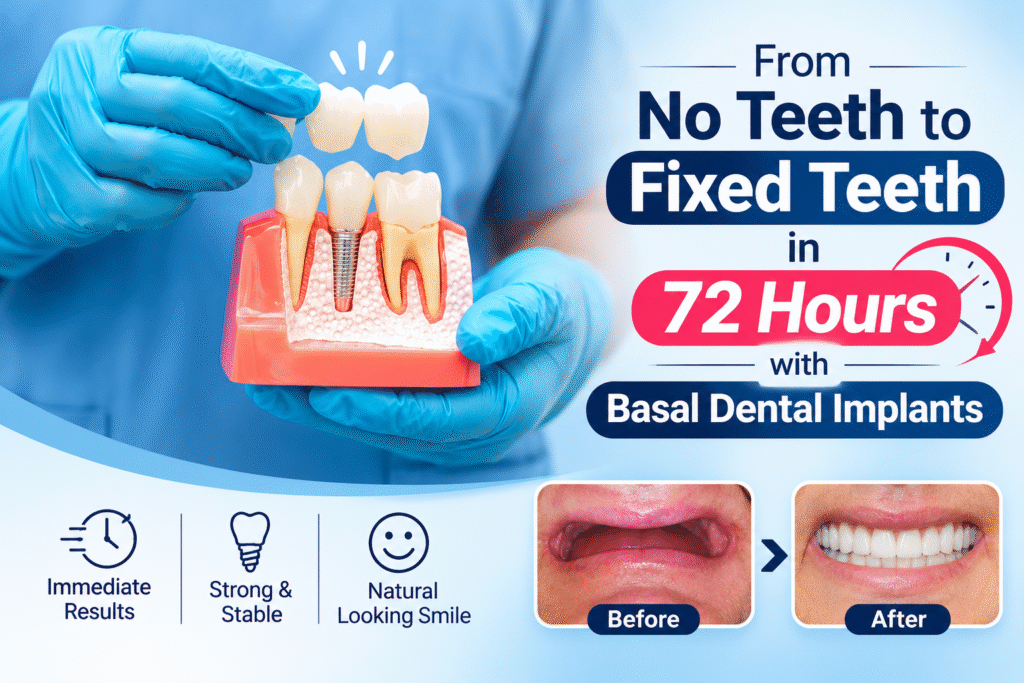
Basal dental implants are designed for a situation that conventional implants cannot always handle: jaws where the bone near the surface has thinned too much to support standard posts. Instead of anchoring in that compromised ridge bone, basal implants reach the denser, more stable layer deeper in the jaw, the bone that tends to hold its density even after years of tooth loss or long-term denture wear. For patients who have been told they are not candidates for conventional implants, or who want to avoid bone grafting, this distinction matters. It is also what makes the 72-hour fixed teeth timeline achievable in suitable cases.
What Basal Implants Are and Why the Bone Layer Matters
The jawbone has two distinct layers with different properties. The ridge bone, the part where natural tooth roots used to sit, is what conventional implants use. It is well supplied with blood and responsive to healing, but it also resorbs and shrinks when teeth are missing. After years of tooth loss or denture wear, this layer can become too thin to hold a standard implant reliably.
The basal bone sits beneath it. It is denser, less affected by tooth loss, and maintains its volume more consistently over time. Basal implants are designed to engage this deeper layer, which is why they can be viable for patients who have already been assessed and turned away for conventional treatment.
The practical implication is straightforward: when the bone near the surface has shrunk, basal implants look for support in the part of the jaw that is still structurally sound.
How Basal Implant Treatment Differs from Conventional Implants
Both approaches replace missing teeth with titanium-based posts and a fixed prosthesis, but the clinical pathway is quite different. Conventional implants anchor in the ridge bone and typically require that bone to be of sufficient height and width, which is why bone grafts and sinus lifts are often part of the treatment when significant resorption has occurred. The process from first surgery to final teeth can extend over several months.
Basal implants anchor in the denser bone that is typically still available even in resorbed jaws, which means grafting can often be avoided. Because the implants engage stable bone from the start, they can frequently be loaded with a fixed temporary bridge within days of surgery rather than after a lengthy healing period.
The implants themselves are also designed differently – generally slimmer, and often placed in a configuration where the posts support each other rather than relying on each one independently. Neither approach is universally superior. Which is appropriate depends on the bone available, overall health, and what the patient is trying to achieve. That determination starts with a 3D scan and a proper examination.
How Fixed Teeth in 72 Hours Actually Works
The 72-hour time frame refers to immediate loading, attaching a fixed set of teeth to the implants shortly after surgery rather than waiting for months of bone integration. It is not a shortcut; it is a protocol that works because basal implants engage bone that is stable enough to bear load from early on.
The process begins before surgery. A CBCT (cone beam CT) scan maps the bone in three dimensions namely height, width, nerve positions, sinus proximity and the implant positions are planned digitally from that data. The temporary bridge is often prepared in advance so it can be fitted without delay once the implants are placed.
Surgery is typically done under local anaesthesia, with sedation available. Implants are placed, impressions are taken, and the temporary fixed bridge is fitted, usually within about three days. That bridge stays in place during the healing period, while the bone settles around the implants. Once healing is confirmed at follow-up, the final long-term bridge replaces the temporary one.
The timeline varies between patients. Not every case is suitable for immediate loading, and what is realistic for a specific jaw is determined at the consultation rather than assumed upfront.
Who Is a Good Candidate?
Basal implants are most commonly considered for patients who have lost all or most of their teeth and want a fixed result rather than removable dentures, who have been assessed and found to have insufficient bone for conventional implants, who struggle with unstable or uncomfortable dentures, or who want to avoid bone grafting procedures and the extended treatment timelines that go with them.
Good general health and a genuine commitment to oral hygiene are prerequisites. Certain conditions require careful evaluation or may make the procedure unsuitable: uncontrolled diabetes, heavy smoking, active gum infection, bone or immune conditions, and medications that affect bone healing all need to be discussed at the consultation. A full clinical and radio-graphic assessment is the only reliable way to establish whether basal implants are the right path for a specific patient.
Risks and Limitations Worth Knowing
Basal implants are a surgical procedure and carry the risks that go with any intervention in the mouth and jaw. Swelling, bruising and discomfort in the first few days after surgery are common. Infection around the implants is possible if hygiene is poor during healing. Implant failure or loosening occurs in a minority of cases. Bite adjustments are sometimes needed after the temporary bridge is fitted as the jaw settles.
The technique is also more demanding than standard implant placement, and outcomes depend heavily on planning quality, surgical experience, and the accuracy of the initial 3D scan. This is a meaningful reason to ask about a practitioner’s specific experience with full-arch basal implant cases rather than implant placement in general.
Long-term success depends on daily brushing, inter-dental cleaning, and regular dental visits – the same maintenance any implant-based restoration requires.
What Recovery Looks Like
Most patients go home the same day and return to light daily activities within a few days. The first 48 to 72 hours typically involve the most noticeable swelling and tenderness; soft foods and prescribed medication manage this period well for most people. During the first two weeks, gentle cleaning and avoiding hard or crunchy foods protect the healing sites.
Over the following months, regular review appointments allow the treating dentist to monitor bone integration and make any adjustments to the bridge. The bone settles gradually around the implants during this period, and the final bridge is not fitted until healing has been confirmed. Following the aftercare instructions closely during this phase has a real bearing on long-term outcomes.
What Basal Implant Treatment Costs
There is no single price because the total depends on how many implants are placed, whether one or both jaws are treated, the materials used for the final bridge, and the clinic’s location and experience level. For patients who would otherwise need bone grafting before conventional implant treatment, basal implants sometimes compare favourably on overall cost by avoiding those preparatory procedures.
The most accurate way to understand what treatment would involve and what it would cost is a consultation with a written treatment plan. That plan should set out the number and type of implants, the bridge specification, what follow-up is included, and the full fee before any commitment is made.
Choosing the Right Surgeon for Basal Implants
The clinical result with basal implants depends significantly on the treating surgeon’s specific experience with this technique. Full-arch immediate-load cases require precise 3D planning, accurate implant positioning, and sound judgement about which cases are genuinely suitable for immediate loading and which are not. These skills develop through case volume, not through general dental or implant training alone.
At a consultation, it is reasonable to ask how many full-arch basal implant cases the surgeon has treated, what 3D imaging and digital planning they use, what their approach is when a case turns out to be more complex than the initial scan suggested, and what follow-up care is included after the final bridge is fitted. A surgeon who is direct and specific in answering these questions is demonstrating the kind of experience that matters for a procedure of this scale.
Basal Implant Treatment at Dr. K Prem Anand’s Clinic, Bangalore
Dr. K Prem Anand is a Facio-Maxillary and Cosmetic Surgeon practising at Celeb U, Banashankari, Bangalore. His qualifications include an MDS in Oral and Maxillofacial Surgery a postgraduate specialisation directly relevant to jaw anatomy and implant surgery alongside a Fellowship in Aesthetic Medicine (Germany), Membership of the American Academy of Aesthetic Medicine (USA), FICOI (USA), LASERPLAST certification (Italy), and advanced training in scar treatment and mesotherapy.
Every basal implant assessment at the clinic begins with a detailed history, 3D imaging where indicated, and an honest conversation about whether basal implants are the right option including when they are not. For enquiries or to arrange a consultation, call +91 8951896994 or visit the clinic’s website.
Commonly Asked Questions
They are designed for long-term use and can last many years with proper oral hygiene and regular dental check-ups. No implant carries a lifetime guarantee – ongoing maintenance is what determines how long the result holds.
The procedure is performed under local anaesthesia, so patients do not feel pain during surgery. Soreness, swelling and tenderness in the days afterward are normal and are managed with prescribed medication. Most people find the post-operative period manageable.
In suitable cases, yes. The 3D scan and clinical assessment determine whether your bone is appropriate for immediate loading. When it is, a fixed temporary bridge can typically be fitted within about three days of surgery. What is realistic for your specific jaw is confirmed at consultation.
Usually not, because they anchor in the denser basal bone that is typically still present even in resorbed jaws. Some cases may require additional steps. Your dentist will explain this after reviewing the 3D scan.
Patients with uncontrolled systemic conditions, active infection in the jaw, certain bone disorders, or medications that significantly affect bone healing may not be suitable or may need those issues addressed first. A full evaluation is the only reliable way to assess eligibility.
All-on-4 uses four conventional implants angled in the available ridge bone. Basal implants use the denser bone deeper in the jaw, which is relevant when ridge bone volume is insufficient for the All-on-4 approach. Both can achieve a fixed full-arch result, which is appropriate depends on the bone anatomy of the individual jaw.
Taking the First Step
For anyone who has been living with missing teeth, unstable dentures, or the news that their bone is not adequate for conventional implants, basal implant treatment is worth a proper evaluation. The 72-hour timeline is real for suitable cases. However, suitability is determined by what the scan shows, not by what a patient hopes or what a clinic promises.
The right starting point is a consultation that includes a 3D scan, an honest assessment of your bone, and a clear explanation of what treatment could look like and what it would cost – with no pressure to decide immediately. Book with Celeb U by Dr. K Prem Anand at , Banashankari, Bangalore.