
Choosing a hair transplant is rarely a simple decision. Most patients don’t walk in asking “FUE or FUT?” – they walk in because their hairline has been retreating for years, or because a photo caught them off guard. The procedure names come later, after the research rabbit hole begins. Somewhere between YouTube videos and clinic websites, FUE, FUT, grafts, donor area, graft survival, and recovery time all start blurring together.
The question that surfaces almost universally: Which is better, FUE or FUT?
The real answer is that it depends – and that’s not a cop-out. It’s the most honest thing a surgeon can tell you at that stage.
Both Follicular Unit Excision (FUE) and Follicular Unit Transplantation (FUT) are well-established hair-restoration techniques. The main difference comes down to how grafts are taken from the donor area. With FUE, individual follicular units are extracted using small circular punches. With FUT, a strip of donor skin is removed and then carefully dissected into individual follicular- unit grafts. After that, the grafts are placed into the recipient area – and that part is broadly similar across both methods.
If you’re considering a hair transplant in Bangalore, getting familiar with these differences will serve you better than picking whichever technique sounds newer or more advanced.
Below are ten questions patients regularly bring up when discussing FUE and FUT – covering scars, recovery, graft survival, eligibility, cost, and aftercare.
Hair Transplant Bangalore FUE FUT: Which Is Better, FUE or FUT?
Neither technique wins across the board – it’s not that kind of question. FUE tends to work well for patients who want to avoid a linear donor scar and prefer a shorter initial recovery. FUT, on the other hand, can be more practical when a surgeon needs to harvest a substantial number of grafts efficiently without over-harvesting the donor area.
With FUE, grafts are removed one by one, leaving multiple small wounds rather than a single incision. Those wounds heal into tiny scars – scattered, and mostly invisible at normal hair lengths, but there. Calling FUE ” scar – less ” is a stretch that reputable surgeons don’t use. FUT removes a skin strip, leaving a linear scar that’s closed with sutures. It’s longer and more defined, but sits low on the scalp and is usually hidden under the surrounding hair.
What tips the decision one way or the other: hair-loss pattern, donor density, scalp characteristics, previous procedures, how you wear your hair, how many grafts you actually need, and what your hair looks like ten years from now. A good consultation addresses all of that – it doesn’t just hand you a menu and ask you to pick.
Does FUE Leave a Scar?
Yes – just a different kind than FUT. FUE makes numerous small circular openings to extract individual follicular units. When done carefully, these typically heal as small, scattered marks that most people wouldn’t notice unless they shaved their head. But ” scar-less ” is not accurate – the International Society of Hair Restoration Surgery (ISHRS) is explicit on this point. An FUT involves a surgical incision whereas an FUE does not.
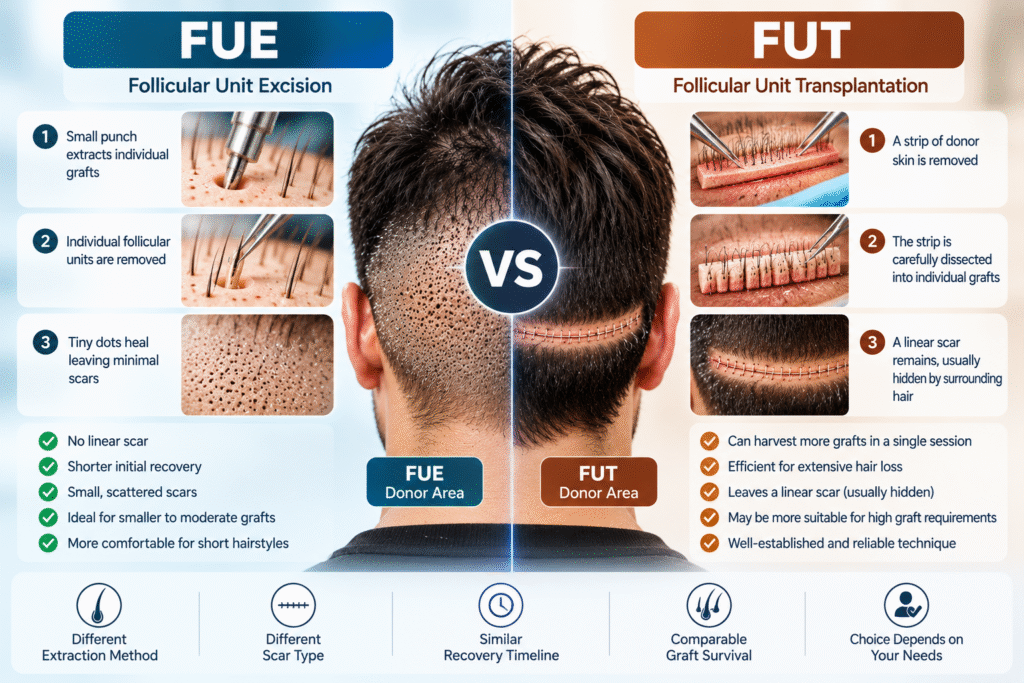
How noticeable FUE scars are depends on punch size, technique, how conservatively the donor area is managed, your skin’s healing tendencies, and whether you regularly cut your hair very short. For patients who want a buzz cut, this conversation matters a lot more than it might seem during the initial consultation.
Is FUT Better if I Need a Large Number of Grafts?
Not automatically – but it can have real advantages for certain patients.
During FUT, a strip of hair-bearing skin is removed from the donor region and dissected under magnification into individual follicular- unit grafts. This can make it easier to harvest a large number of grafts without creating punch sites across a wide area of the scalp.
FUE extracts grafts individually, which works extremely well for many patients – but high-volume sessions require careful planning to avoid over-thinning the donor area.
The key point: more grafts needed doesn’t automatically mean FUT. Fewer grafts needed doesn’t automatically mean FUE. Donor characteristics and how your hair loss is likely to progress matter just as much as the immediate graft count. A surgeon should always be thinking about the donor area ten years out, not just today’s session.
Which Has Better Graft Survival: FUE or FUT?
This is one of the most common questions – and it’s the wrong frame.
In well-performed cases with appropriately selected patients, both FUE and FUT can achieve strong graft survival. Graft survival isn’t determined primarily by the harvesting method – it’s shaped by donor hair quality, extraction technique, how grafts are handled outside the body, hydration, storage, recipient-site preparation, and postoperative care.
Asking a clinic “what percentage of your grafts survive?” gives you a number, but not much context. A more useful set of questions: How are grafts harvested and handled? Who performs each stage of the procedure? What’s the implantation protocol? The ISHRS specifically recommends that patients find out who is responsible for diagnosis, surgical planning, harvesting, recipient-site creation, and postoperative management – because those roles aren’t always held by the same person.
How Long Does Recovery Take After FUE vs FUT?
FUE typically has a faster initial recovery because there’s no strip incision to heal – but “faster recovery” doesn’t tell the whole story.
After either procedure, patients usually deal with some redness, swelling, tenderness, crusting, or scalp tightness in the first few days. With FUT, there’s also the donor wound and sutures to account for, which adds to that experience.
Worth keeping in mind: being cleared to go back to work is very different from having final results. The transplanted hair almost always sheds in the weeks following surgery before new growth begins. Real, visible growth is gradual, and full results take several months – sometimes closer to a year. Your surgeon should give you a realistic, personalized timeline rather than a one-size-fits-all answer.
Which Is More Painful, FUE or FUT?
Both are done under local anaesthesia, so significant pain during the procedure itself usually isn’t the main concern for most patients.
Afterwards, it’s a different experience per person. FUT can produce tightness or discomfort around the linear donor incision. FUE tends to create soreness spread across multiple small extraction sites. Which feels worse varies – and comparing the two purely on pain can be misleading.
The more useful thing to ask at consultation: how is postoperative discomfort managed, and what instructions will you receive around medication, washing, sleeping position, and activity levels? The ISHRS also flags that hair transplantation is still a surgical procedure, even when clinics use language like “minimally invasive” – patients should go in with realistic expectations.
Who Is a Good Candidate for FUE or FUT?
Not everyone with hair loss is ready for a transplant – and that’s an important distinction.
A proper assessment should look at the cause and pattern of hair loss, donor density, whether the loss has stabilised, and factors like age, hair calibre, family history, and what the patient actually expects to achieve.
Patients without adequate donor hair may not be able to get the density they’re hoping for. Patients whose hair loss is still active or whose cause isn’t clearly established may need medical evaluation before any surgery is on the table.
Younger patients carry extra complexity here. Hair loss that seems manageable at 24 can look very different at 34. A hairline designed without accounting for future progression can end up looking unnatural as surrounding hair continues to thin – and it may have used up donor supply that can’t be replaced.
A consultation should answer two questions honestly: Can this patient undergo transplantation safely? And can transplantation actually deliver a result that holds up long-term?
Is FUE More Expensive Than FUT in India?
Usually, yes – though the gap varies considerably depending on the clinic and the patient’s specific case.
The price difference comes partly from the time and labour involved in extracting grafts individually during FUE. ISHRS also notes this – FUT can generally be completed at lower cost.
In Bangalore specifically, there’s no single standard price. Estimates from Practo show approximately ₹20–₹40 per graft for FUT and ₹35 – ₹75 per graft for FUE – with the final figure depending on graft count, surgeon experience, clinic standards, complexity, and what the quoted price actually includes.
A very low price should prompt questions, not excitement. Find out who performs the surgery, what’s included in the quote, and what postoperative care looks like before making any decisions based on cost.
Can I Go Back to Work Quickly After a Hair Transplant in Bangalore?
For desk-based work, many patients return within a few days – though the first week usually involves visible redness, some crusting, and a scalp that doesn’t look entirely normal.
Jobs that involve physical labour, heat, dust, or strenuous activity need a longer pause. Bangalore’s climate is also worth factoring in – heat, sweating, outdoor exposure, and traffic pollution all create additional challenges during the early healing period.
Your surgeon should give you specific instructions on:
When and how to wash the scalp
Protecting the recipient area
When to resume exercise
Wearing helmets or headgear
Sun exposure and swimming timelines
Medications and topical products
Don’t improvise based on what you saw someone do on social media. Their scalp isn’t yours, and anecdotal evidence makes for a poor medical protocol.
What Kind of Aftercare Is Important in Bangalore After FUE or FUT?
Aftercare isn’t a minor footnote – it’s part of the procedure.
For Bangalore patients, the practicalities of daily life matter: commuting, outdoor heat, sweating, and pollution exposure all need to be thought through during the early healing window. Keeping the scalp clean per the clinic’s specific instructions and avoiding friction or trauma is especially important in that first phase.
Attend all follow-up appointments – they exist so your surgical team can check healing progress and catch anything that needs attention early.
One thing that surprises patients: a transplant doesn’t stop existing hair from thinning. Depending on your diagnosis, medical treatment for the non -transplanted hair may be part of a complete plan. A good transplant considers both the hair being added and the hair already there.
How Do I Choose the Best Hair Transplant Clinic in Bangalore?
Not by advertising budget, not by which technique sounds most advanced, and not by the lowest quote.
Start by finding out who actually performs each part of the procedure. Surgical hair restoration requires medical judgement at every stage – diagnosis, hairline design, graft distribution planning, harvesting, transplantation. Those aren’t all automatically the same person, and knowing who does what matters.
Before committing, ask:
1. Who is the surgeon responsible for my procedure?
2. What is the cause and pattern of my hair loss?
3. Why is FUE or FUT being recommended specifically for me?
4. How many grafts do I actually need?
5. What is the long-term donor-area plan?
6. What type of scar should I expect?
7. Who performs the graft harvesting and recipient-site creation?
8. What does the quoted cost include?
9. What is the expected recovery timeline?
10. What follow-up and aftercare will I receive?
Look for honest, specific explanations. Walk away from promises of ” scar-less “, “100% guaranteed,” or instant results. The ISHRS specifically cautions against clinics that make exaggerated claims and recommends choosing appropriately trained, licensed medical professionals for any hair-restoration surgery.
Final Takeaway: FUE or FUT?
So which is actually better – FUE or FUT?
The better technique is whichever one fits your hair-loss pattern, donor capacity, goals, hairstyle, medical suitability, and what your hair situation is likely to look like down the line. Neither technique has a universal answer, and any clinic that tells you otherwise is simplifying something that isn’t simple.
FUE extracts grafts individually, avoids a linear strip scar, and leaves small scattered scars instead. FUT can harvest efficiently for selected patients needing substantial restoration, but leaves a linear donor scar. Both techniques, done well by a qualified surgeon, can produce natural-looking, lasting results.
For anyone considering a hair transplant Bangalore FUE FUT consultation, the first step is a proper assessment – not choosing a technique from a brochure.
A successful transplant isn’t about getting as many hairs as possible in a single session. It’s about using limited donor hair intelligently, designing a hairline that makes sense for your age, protecting the donor supply for future needs, and achieving something that still looks right ten or twenty years from now.
Frequently Asked Questions
Which is better, FUE or FUT hair transplant?
Neither is universally better. FUE suits patients who want to avoid a linear donor scar. FUT can be advantageous in selected patients who need efficient harvesting of larger graft numbers. The right answer depends on your individual case.
Is FUE completely scar – less?
No. FUE leaves small scars at individual extraction sites. FUT leaves a linear donor scar. No surgical hair-transplant technique is genuinely scarless.
Does FUT have better graft survival than FUE?
Both can achieve strong graft survival when properly planned and performed. Survival is shaped by harvesting method, graft handling, storage, implantation technique, donor quality, and postoperative care – not by the name of the procedure.
Is FUE more expensive than FUT in India?
FUE is generally more expensive because individual graft extraction takes more time and labour. Actual pricing varies widely by graft count, surgeon, clinic, and procedure complexity.
How long does a hair transplant take to show results?
Hair restoration is gradual. Initial healing happens relatively quickly, but visible final results develop over several months. Expect growth to be progressive, not immediate.
Can everyone with hair loss undergo a transplant?
No. Adequate donor hair, a confirmed diagnosis, stable hair loss, and realistic expectations are all important prerequisites before surgery is considered.
Can I return to work after an FUE transplant?
Many patients resume desk-based work fairly soon, but the timeline depends on healing, the type of work, and what the procedure involved.
Is FUT painful?
Both procedures are done under local anaesthesia. Some postoperative tenderness or tightness is normal – particularly around the linear donor incision with FUT.
What should Bangalore patients consider during recovery?
Heat, sweating, dust, outdoor exposure, and commuting all factor in during the first few days. Follow your clinic’s specific instructions for scalp washing, sun protection, exercise, and care.
How should I choose a hair transplant clinic in Bangalore?
Prioritise a qualified, appropriately trained medical professional who personally evaluates your hair loss, explains the recommended technique, discusses risks and long-term planning, and provides structured postoperative care. Don’t let price be the deciding factor.