
Dermal Fillers vs. Botox: Which Anti-Aging Treatment Is Right for You?
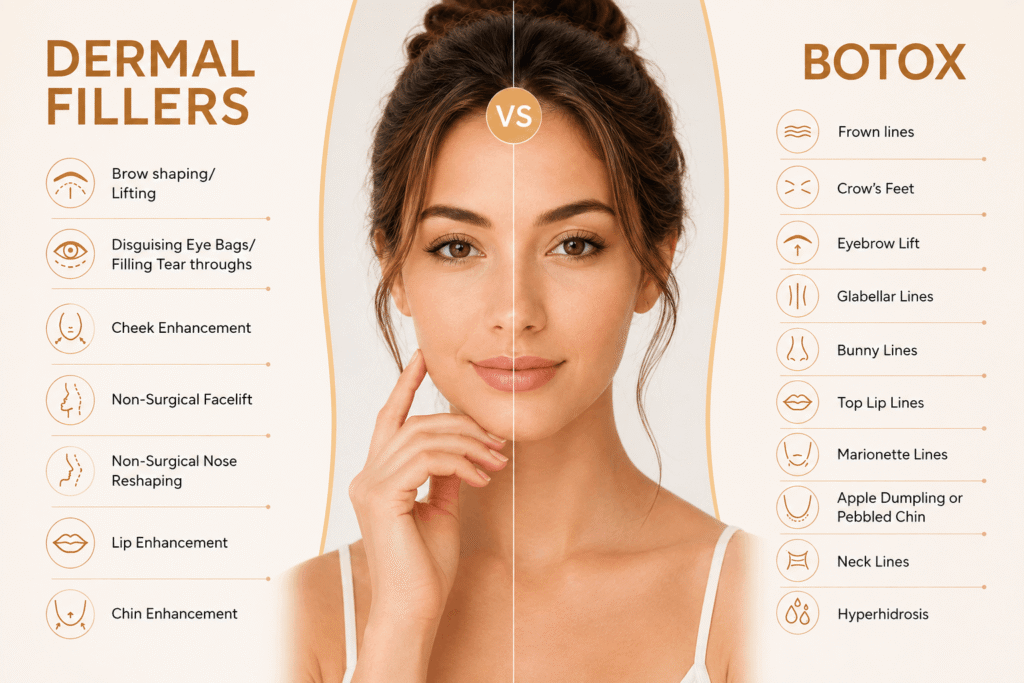
Two names dominate every conversation about non-surgical anti-aging treatment: Dermal Fillers vs. Botox. They are often mentioned in the same breath, sometimes even used interchangeably, and that is a mistake that can lead to the wrong treatment, unrealistic expectations, and disappointing results.
The truth is, while both are minimally invasive injectable treatments performed in a clinic setting, they work through entirely different mechanisms and are suited to different concerns. Understanding exactly how each works and, more importantly, which one addresses your specific skin concerns is the foundation of a successful cosmetic dermatology outcome.
This guide breaks down everything you need to know, from mechanism to cost, so you can walk into your consultation already informed.
What Is Botox? The Science Behind the Relaxation
Botox is the brand name for Botulinum Toxin Type A, a purified neurotoxin derived from Clostridium botulinum bacteria. When injected in controlled, therapeutic doses, it temporarily blocks the release of acetylcholine, the neurotransmitter that signals muscle contraction. The targeted muscles relax, and the overlying skin smooths out.
It is important to understand what Botox does and does not treat. Botox is specifically effective for dynamic wrinkles lines that form as a result of repeated facial muscle movement.
These include:
- Horizontal forehead lines (from raising the eyebrows)
- Glabellar lines, the “11s” or frown lines between the brows
- Crow’s feet around the outer corners of the eyes
- Bunny lines along the nose bridge
- Lip lines and a subtle lip flip
- Platysmal bands on the neck (Nefertiti lift)
FDA-approved for cosmetic use since 2002, Botox has become the most widely performed non-surgical cosmetic procedure globally. In 2024, over 9 million Botox treatments were performed worldwide, underscoring its safety profile, predictability, and clinical track record.
Results typically begin to appear within 3 to 5 days post-treatment, with full effect visible at approximately two weeks. The duration of effect is generally 3 to 4 months, after which the nerve signals resume, and muscle activity gradually returns. Patients who undergo regular maintenance treatments over several years often find their results lasting longer as the targeted muscles weaken with disuse.
What Are Dermal Fillers? The Architecture of Volume Restoration
Dermal fillers are injectable gel-like substances that physically add volume beneath the skin’s surface. Unlike Botox, which targets muscle activity, fillers address static concerns features and lines that are visible even when the face is at rest, or areas where volume and structural support have diminished over time. There are several categories of dermal fillers, each with distinct properties:
Hyaluronic Acid (HA) Fillers
The most commonly used filler category globally, HA fillers (brands include Juvéderm, Restylane, and Belotero) are made from a naturally occurring sugar molecule already present in the body. They attract and retain water, adding immediate volume and hydration. A key clinical advantage: HA fillers are reversible they can be dissolved using an enzyme called hyaluronidase in the event of overcorrection or an adverse event. Results typically last 6 to 18 months, with global hyaluronic acid filler procedures rising 29% reaching 5.5 million procedures worldwide in 2023.
Calcium Hydroxylapatite (CaHA)
Sold under the brand name Radiesse, CaHA is a biostimulatory filler that not only adds immediate volume but also stimulates natural collagen production over time. Results typically last 12 to 18 months. It is well-suited to deeper volume restoration in areas such as the cheeks and hands.
Poly-L-Lactic Acid (PLLA)
Sculptra is the leading PLLA filler a collagen stimulator rather than a direct volumiser. Results emerge gradually over several months as the body builds new collagen, and can last up to two years or more. It is best suited to patients seeking subtle, progressive improvement.
Polymethylmethacrylate (PMMA)
Bellafill is a semi-permanent filler that contains tiny microspheres which remain beneath the skin to provide ongoing structural support. Duration can extend beyond five years. It requires careful patient selection and an experienced injector.
Common treatment areas for dermal fillers include the lips (lip augmentation), cheeks and midface (volume restoration), nasolabial folds (smile lines), under-eyes (tear troughs), jawline, and chin projection.
Dermal Fillers vs. Botox: A Side-by-Side Comparison
The most efficient way to understand the difference is to see them placed directly against each other across the criteria that matter most to patients:
| Botox | Dermal Fillers | |
| Mechanism | Relaxes targeted muscles by blocking nerve signals (acetylcholine) | Adds volume and structure beneath the skin surface |
| Primary Use | Dynamic wrinkles from facial movement | Static wrinkles, volume loss, contouring |
| Best Areas | Forehead, frown lines, crow’s feet, brow lift | Lips, cheeks, nasolabial folds, jawline, under-eyes |
| Onset of Results | 3–5 days; full effect in 2 weeks | Immediate; settles within 1–2 weeks |
| Duration | 3–4 months on average | 6 months to 2+ years (varies by filler type) |
| Reversibility | Wears off naturally; not reversible | HA fillers can be dissolved with hyaluronidase |
| Downtime | None to minimal | Minimal; bruising/swelling possible for 1–7 days |
| Cost per Session | USD 300–600 (avg. USD 385) | USD 600–1,500+ per syringe |
| Frequency | 3–4 times per year | 1–2 times per year depending on filler |
| Side Effects | Bruising, headache, temporary drooping (rare) | Swelling, bruising, rare vascular complications |
| FDA Approved | Yes (since 2002 for cosmetic use) | Yes (various HA, CaHA, PLLA, PMMA fillers) |
Common Misconceptions — Addressed
“Dermal Fillers vs. Botox are the same thing”
They are not. Botox is a neurotoxin that affects muscle activity; fillers are volumising gels that sit in tissue space. The only similarity is that both are injected.
“Botox freezes your face completely”
A well-administered Botox treatment by a skilled practitioner should preserve natural facial movement while softening dynamic lines. The “frozen” look results from over-treatment, not from the product itself.
“Dermal Fillers are permanent”
The vast majority of fillers in use today particularly hyaluronic acid fillers are temporary and biodegradable. They metabolise naturally over time. Semi-permanent options exist but require specific candidacy and counselling.
“Younger patients don’t need Dermal fillers”
Volume loss in the midface and temples can begin as early as the late twenties. Additionally, lip augmentation and subtle contouring with fillers are routinely performed on patients in their mid-twenties to early thirties, not as a corrective measure but as an enhancement.
Can You Combine Dermal Fillers vs. Botox?
Yes and in many cases, combining both treatments delivers superior results to either alone. This approach is often referred to as a “liquid facelift” in aesthetic medicine.
The logic is complementary, Botox relaxes the upper face muscles responsible for dynamic lines, while fillers restore volume and structural support in the mid and lower face. Used together, they address both dynamic and static aging simultaneously. There is also a clinical benefit: Botox reduces the muscle movement that accelerates filler breakdown, potentially extending the longevity of filler results.
Which Is Right for You? A Decision Framework
The right treatment depends on what you are looking to address: Dermal Fillers vs. Botox. Use this as a starting point:
Choose Botox if you want to:
- Soften expression lines that appear when you smile, squint, or frown
- Prevent deeper wrinkle formation over time (preventative Botox)
- Achieve a subtle brow lift without surgery
- Address neck bands or a “gummy smile”
Choose Dermal Fillers if you want to:
- Restore volume in hollowed cheeks, under-eyes, or temples
- Enhance lip size, shape, or definition
- Smooth deep static lines visible at rest – such as nasolabial folds
- Add projection and definition to the chin or jawline
- Correct facial asymmetry or structural imbalance
Consider both if you want:
- Comprehensive facial rejuvenation addressing multiple concerns simultaneously
- Natural-looking results that address both skin texture and structural volume
- Longer-lasting outcomes through synergistic treatment effects
Cost Considerations in India
In India, the cost of Botox treatment typically ranges from ₹8,000 to ₹30,000 per session depending on the number of units administered and the areas treated. Dermal filler treatments range from ₹15,000 to ₹60,000+ per syringe, depending on the product used, the treating physician’s expertise, and the clinic’s location. At premium cosmetic dermatology clinics staffed by qualified cosmetic surgeons such as Celeb U pricing reflects not just the product cost but the clinical expertise, safety protocols, and post-treatment support that underpin safe outcomes.
Why Expertise Is Non-Negotiable
Both Botox and dermal fillers are medical procedures. In the wrong hands or using substandard products both carry risks ranging from asymmetry and lumps to, in rare cases, serious vascular complications with fillers. The safety record of these treatments in peer-reviewed literature reflects outcomes achieved by trained practitioners using approved products in clinical settings. At Celeb U, every injectable treatment is performed or directly supervised by our senior cosmetic surgeons with expertise in facial anatomy and aesthetic medicine. We use only internationally certified, FDA-aligned products and maintain strict clinical protocols.
Not sure where to start? Book a consultation with Celeb U’s cosmetic surgery team. We’ll assess your anatomy, listen to your goals, and design a treatment plan that fits whether that is Botox, the best dermal fillers for your concern, or a thoughtfully designed combination protocol.